
Have you ever taken a close look at a fire extinguisher and wondered what all those tags, seals, and labels actually mean? Between inspection records, manufacturer specifications, and various safety indicators, there’s quite a bit of information packed onto these life-saving devices. Each element plays a specific role in ensuring your equipment functions properly when seconds count.
Learning to interpret these markings isn’t just good practice—it’s crucial for maintaining compliance with safety regulations, satisfying insurance requirements, and most importantly, protecting lives and property. This guide walks you through every tag and label you’ll encounter, explaining what they mean and why they matter for your facility’s fire safety program.
Labels and tags you’ll encounter
Most fire extinguishers, regardless of size or type, will display these standard elements:
Manufacturers Label – Displays the manufacturer details, operating instructions, model information, and approved fire types
Production Date Mark – Indicates the cylinder’s manufacturing date
Service Record Tag – Logs maintenance and inspection history
Safety Seal – Shows whether the activation pin remains intact
Depending on the extinguisher type, you may also see:
Pressure Test Label – Required for specific rechargeable and high-pressure units that must undergo routine internal checks and pressure testing
Six-Year Service Label – Applied after comprehensive six-year maintenance procedures
Note that pressure test labels and six-year service labels often look similar, and sometimes a single label serves both functions.
Manufacturer’s label explained
Affixed by the manufacturer, this label provides essential operating information:
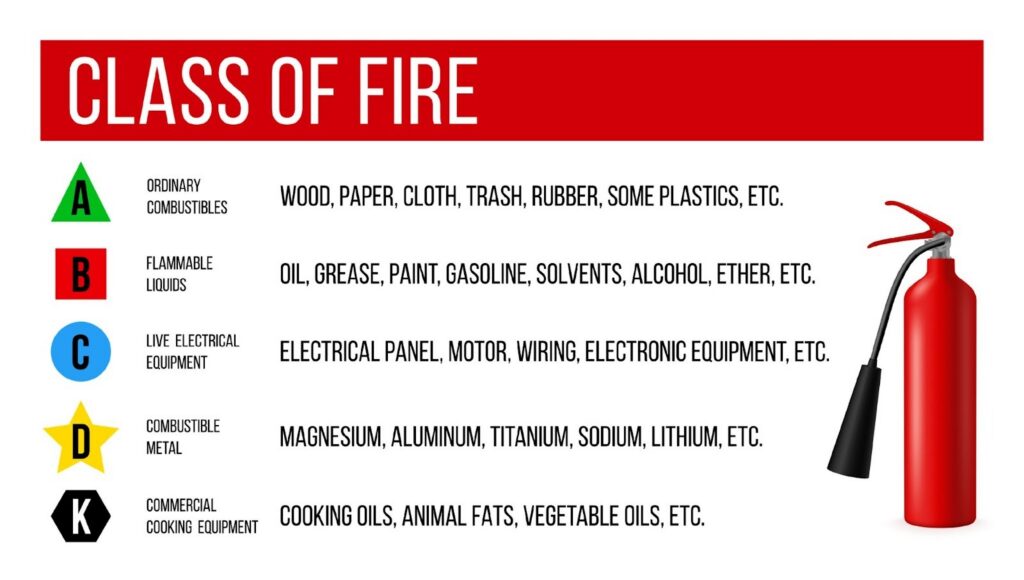
- Fire classifications the unit can handle (A, B, C, D, or K)
- Step-by-step usage instructions with visual guides
- Important safety information and warnings
- Manufacturer identification and contact details
- Production date information
- UL (Underwriters Laboratory) certification
The UL certification is critical—if any portion of the label containing UL information becomes damaged or removed, the extinguisher must be taken out of service immediately.
Fire classifications are typically shown using both text and images to ensure clear communication. The NFPA defines five fire types:
Locating the production date
It’s important to be able to find the date your extinguisher was manufactured because it determines the schedule for professional inspections, maintenance, and testing. There are two places you’ll typically find this information:
- On the brand label near the serial number or UL mark.
- Stamped directly onto the cylinder base.
Service record tags
OSHA and NFPA regulations mandate that all workplace extinguishers carry documentation of their latest inspection and service. These tags track service history to confirm the unit remains operational.
Service tags vary in design and material. They might be attached via clip or wire, made from paper or Tyvek material. For outdoor installations or vehicle mounting, UV-resistant plastic or vinyl stickers applied directly to the cylinder are common.
Typical tags feature a grid showing the current or next year with all twelve months listed. During annual inspections, certified technicians punch holes corresponding to the service date. Your next professional inspection is due one year from that punched date. Tags also record:
- The technician’s license number
- Technician’s signature
- The type of inspection performed
Hydrostatic testing label
Hydrostatic pressure testing applies to certain rechargeable extinguisher models. This process involves completely emptying the cylinder for thorough internal and external examination, testing the unit at maximum pressure specifications, and fully recharging it.
Units requiring this procedure display a dedicated pressure testing label showing the last test date, allowing you to calculate when the next test is due. For extinguishers never tested, use the manufacturing date as your starting point for scheduling.
Safety seals: your tamper indicator
Safety seals—sometimes called tamper indicators, security ties, or tamper seals—are small plastic or wire fasteners securing the handle and activation pin together. The pin cannot be removed without breaking this seal. Any extinguisher with a broken seal requires immediate professional inspection, servicing, and recharging, regardless of why the seal was broken.
This requirement exists because even minimal discharge can cause pressure loss, potentially rendering the extinguisher useless during emergencies. An extinguisher with a compromised seal may violate fire safety regulations and could invalidate insurance coverage for fire-related losses. Annual inspections must include seal replacement by qualified professionals.
Keeping your primary fire defense system ready
Portable extinguishers are your first defense against small fires, preventing them from escalating into major disasters. Every label and tag serves the same fundamental goal: guaranteeing your extinguisher functions properly when needed. When questions arise about any extinguisher’s status, professional consultation is always recommended.
From helping you to select the correct extinguishers for your organization to inspecting and maintaining them, Summit Fire National Accounts is here to ensure your multi-site business is always safe and meeting all regulatory and insurance requirements. Our nationwide network delivers industry-specific fire and life safety solutions through centralized management and trusted partners across the United States, supported by more than 125 branch offices — and growing.
Reach out to the Summit Fire National Accounts team today for a free quote for your multi-site business.